AI in hospitality is often discussed in terms of efficiency.
How much can we automate?
How many tasks can we remove?
How much faster can we process information?
How much can we save?
These are relevant questions. But perhaps they focus too much on what technology does and not enough on what people can do as a result.
Because one of the most valuable things AI can give a hotel organisation may be something remarkably simple:
Time.
Time for Revenue Managers to interpret rather than collect data.
Time for commercial teams to think rather than administer.
Time for hotel employees to focus on guests rather than repetitive processes.
And time for leaders to make better decisions.
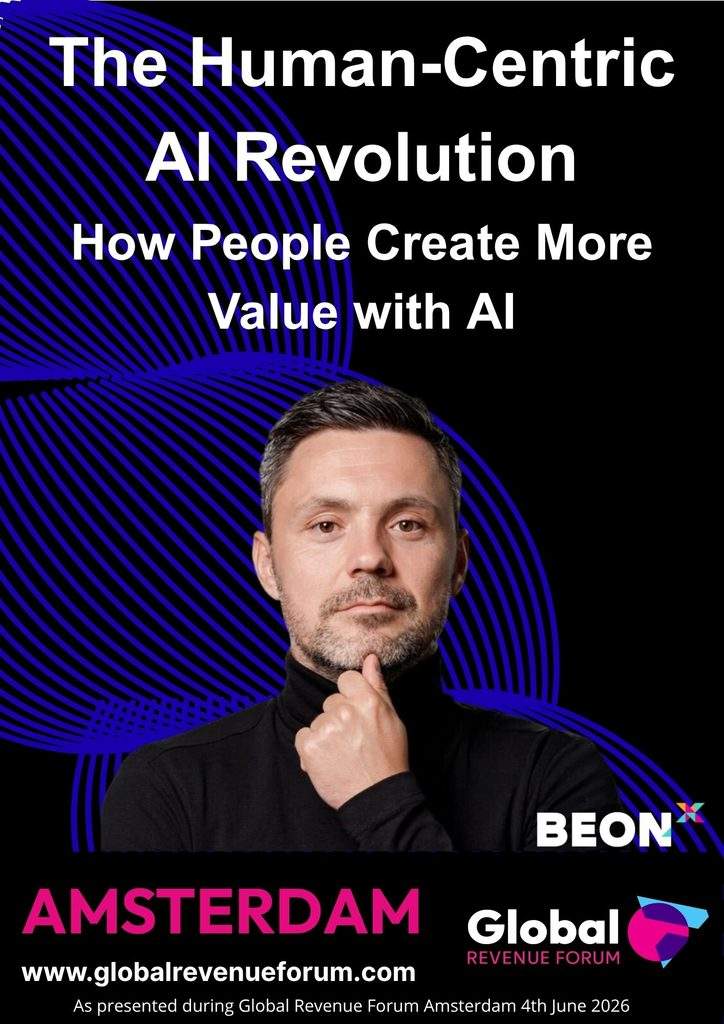
This was at the heart of the session presented by Tomasz Leszczynski, Chief Revenue Officer at BEONx, during Global Revenue Forum Amsterdam.
There is an understandable fascination with what AI can do.
It can analyse enormous amounts of data.
It can recognise patterns.
It can identify opportunities.
It can automate repetitive processes that previously required significant amounts of human time.
But automation itself does not necessarily create value.
The more interesting question is:
What happens with the time automation creates?
The whitepaper developed from Tomasz's GRF Amsterdam session presents a simple framework:
Automation → More Time → Better Decisions → Better Experiences → Better Results
It is a useful way of looking at AI because it shifts the conversation away from technology itself and towards the outcome we want technology to create.
Revenue Management has become increasingly data-driven.
That has created enormous opportunities, but it has also created a considerable workload.
Revenue Managers can spend significant amounts of time pulling reports, checking data, comparing performance, analysing competitors and identifying changes in booking behaviour.
AI can process much of this information far faster than a human can.
But that does not make the Revenue Manager redundant.
It potentially makes the Revenue Manager more valuable.
Instead of spending time gathering information, the Revenue Manager can spend more time asking:
Why is this happening?
What does it mean for our strategy?
Should we act?
What are the commercial consequences?
How does this affect other departments?
The whitepaper makes this distinction clearly: AI recommendations can provide a starting point, while experience and judgement remain essential when making the final decision.
AI can identify a pattern.
A Revenue Manager still needs to understand the business behind it.
This distinction matters because faster is not automatically better.
Producing a forecast faster has limited value if nobody uses the additional time to challenge the assumptions behind it.
Generating another dashboard creates little value if it does not change a decision.
Automating a report is useful, but the real value appears when the person who previously spent an hour producing it can instead spend that hour interpreting it, discussing it with colleagues or acting on the opportunity it reveals.
Technology creates potential.
People turn that potential into value.
And that is why the relationship between people and AI is perhaps more interesting than the question of which tasks AI will eventually replace.
The same principle applies across the commercial organisation.
Sales teams can spend less time on repetitive administrative work and more time developing customer relationships.
Marketing teams can use technology to process and interpret data while spending more time on strategy, creativity and understanding customer behaviour.
Commercial leaders can identify processes that consume time without creating corresponding value.
General Managers can give their teams tools that support better decisions without removing ownership of those decisions.
The whitepaper argues that competitive advantage comes from people supported by technology, and that AI should become part of the organisational culture rather than simply another component of the technology stack.
That is an important distinction.
Implementing AI is not necessarily an AI strategy.
The real question is whether the organisation is becoming better because of it.
Probably not the AI.
Guests are unlikely to care whether an algorithm analysed the data behind a decision.
They do notice when service is faster.
They notice when communication feels relevant.
They notice when an employee has the time to listen.
They notice when the hotel seems to understand what they need.
As the whitepaper puts it, technology may operate invisibly behind the scenes, while its value becomes visible through better service, greater personalisation and employees having more time to focus on the guest.
This may be particularly important in hospitality.
We are an industry built around human experiences.
Technology should not necessarily make hospitality less human.
Used well, it may give us the opportunity to make it more human.
There is another important consequence.
As technology becomes better at analysing information and recommending actions, human expertise does not become less important.
It changes.
Knowing how to produce the report may become less valuable.
Knowing whether the recommendation makes commercial sense becomes more valuable.
Knowing how to challenge an assumption becomes more valuable.
Understanding the guest, the market and the wider business becomes more valuable.
And being able to connect insights across Revenue, Sales, Marketing and Operations becomes more valuable.
The organisations that benefit most from AI may therefore not be those that automate the greatest number of tasks.
They may be the ones that make the best use of the human capacity that automation releases.
Perhaps we should stop asking only:
"What can AI do for us?"
And start asking:
"What can our people do better because of AI?"
Automation can create time.
But time alone does not create value.
Value is created when that time is used for better decisions, stronger collaboration, more strategic thinking and better guest experiences.
The future of hospitality does not have to be a choice between people and technology.
The opportunity lies in making them better together.
This article is based on the session presented by Tomasz Leszczynski, Chief Revenue Officer at BEONx, during Global Revenue Forum Amsterdam.
Download the full GRF Insights whitepaper, The Human-Centric AI Revolution: How People Create More Value with AI, to explore the framework and practical implications for Revenue Managers, commercial leaders and General Managers.