AI hotel marketing is rapidly becoming one of the most important topics in hospitality. For more than two decades, hotels have invested heavily in digital visibility, search engine optimisation and website conversion. As travellers increasingly use AI-powered tools to discover and compare hotels, commercial teams must adapt their digital strategies to remain visible and competitive.
We learned how to improve search rankings.
We optimised our websites.
We monitored conversion rates.
We refined booking journeys.
Success was largely determined by one question:
Can potential guests find us online?
That question is still important.
But it is no longer the only one.
A growing number of travellers are beginning their journey with AI-powered search and recommendation tools. Instead of clicking through multiple websites and comparing dozens of options, they are increasingly asking questions and receiving recommendations directly from AI assistants.
This creates a new challenge for hospitality businesses.
Can AI find and understand your hotel?
The Shift from Search to Discovery
Traditional search engines present travellers with a list of options.
The traveller decides what to click.
AI-assisted search works differently.
Instead of presenting links, the system often interprets information and provides a recommendation.
That recommendation is influenced by thousands of signals gathered from websites, reviews, online travel agencies, social media, articles and other digital sources.
In other words:
Guests may increasingly discover your hotel through AI's interpretation of your business rather than through your own website.
Why This Matters for Hotels
Most hotels have spent years improving their digital presence.
Yet many organisations still think about visibility primarily in terms of:
- Website traffic
- Search rankings
- Paid advertising
- Direct bookings
Those metrics remain important.
However, AI introduces a new layer between the guest and the hotel.
If AI cannot clearly understand who you are, what you offer and why guests should choose you, your visibility may suffer even if your traditional marketing efforts are strong.
This is not a technology problem.
It is a communication problem.
Your Digital Reputation Is Becoming More Important
AI systems do not rely on a single source of information.
They build an understanding of your business from multiple sources.
This means that consistency matters more than ever.
Hotels should ask themselves:
- Is our positioning clear across all channels?
- Do reviews reinforce our key strengths?
- Are we communicating our unique value proposition consistently?
- Is our content helping both guests and AI understand who we are?
The businesses that communicate clearly are often easier for both people and machines to understand.
Commercial Teams Must Adapt
This shift is not solely a marketing issue.
Revenue Management, Marketing, Sales and Distribution all have a role to play.
Visibility influences demand.
Demand influences pricing.
Pricing influences performance.
The organisations that perform best in the years ahead are likely to be those that treat digital visibility as a commercial responsibility rather than a marketing activity.
The Future Is Not Search or AI
It Is Both
Search engines are not disappearing.
Websites are not disappearing.
Direct bookings are not disappearing.
But the way travellers discover information is changing.
Hotels that continue to focus exclusively on traditional digital marketing may find themselves missing an important part of the guest journey.
The question is no longer:
Can guests find your hotel online?
The question is:
Can AI understand why they should choose it?
Further Reading
This article was inspired by the GRF Insights White Paper:
The AI Generation Gap: How Artificial Intelligence Is Reshaping Hospitality Discovery
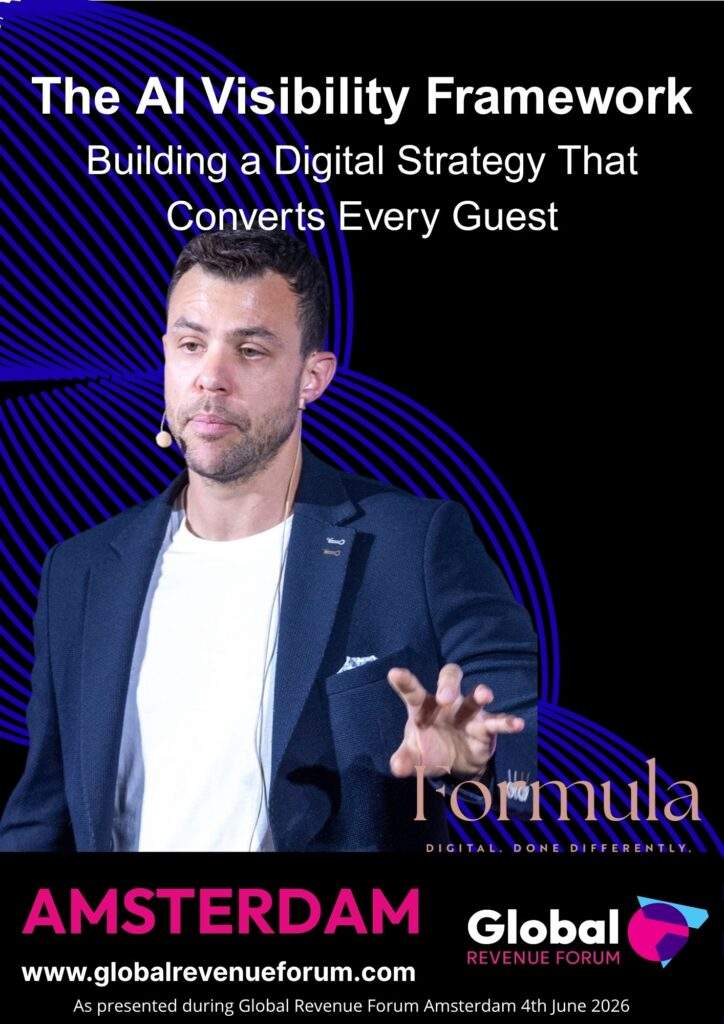
Presented by Adam Hamadache at Global Revenue Forum Amsterdam 2026.
Download the full White Paper here.
About the speaker
Adam Hamadache is Founder of Formula Digital and a recognised expert in hotel digital marketing, AI visibility and search strategy. He helps hospitality businesses understand how evolving search behaviour, AI-driven discovery and digital trust influence commercial performance.