Hotels spend enormous amounts of time optimising revenue.
We analyse pricing. We invest in technology. We review distribution costs. We improve conversion. We measure RevPAR, ADR and profitability.
But there is another cost sitting inside the hotel that we do not always treat as a commercial issue:
Employee turnover.
When an experienced employee leaves, the cost is not limited to recruiting their replacement.
There is onboarding. Training. Overtime. Reduced productivity. Lost knowledge. And potentially an impact on the guest experience long before that cost becomes visible in the financial results. These are among the hidden costs explored in our latest Global Revenue Forum Insights white paper. GRF Amsterdam 2026 Whitepaper #…
So perhaps employee turnover should not only be a conversation for HR.
Perhaps it belongs on the commercial agenda too.
In this post, we will look at:
Some costs are relatively easy to see.
When someone leaves, we need to recruit a replacement. We need to onboard them. Someone needs to train them. Other employees may need to cover shifts or take on additional responsibilities in the meantime.
But some of the most important costs are much harder to put into an Excel sheet.
An experienced employee knows the hotel.
They know the systems. They know the routines. They know their colleagues. They understand the guests. They know what tends to go wrong and, perhaps more importantly, how to prevent it from going wrong.
When that person leaves, their knowledge leaves with them.
The white paper describes this as one of the greatest invisible losses associated with turnover: a knowledge gap that can affect service quality before its impact becomes visible in the financial results. GRF Amsterdam 2026 Whitepaper #…
And that makes employee turnover a much broader business question.
Quite a lot.
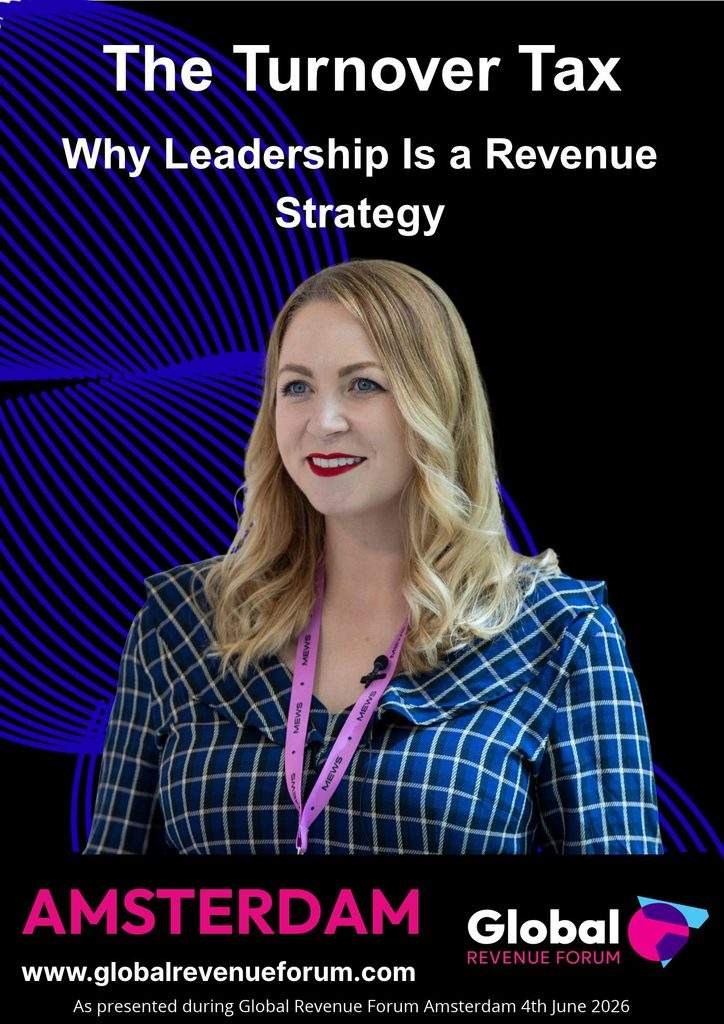
One of the central messages from Alicia Dick Wahlberg's session at Global Revenue Forum Amsterdam was that employee retention is not simply an HR responsibility.
It is a leadership responsibility.
The session highlighted the significant role managers play in employee engagement and retention. Clear expectations, regular feedback and meaningful conversations can influence whether employees stay, develop and contribute to the organisation. GRF Amsterdam 2026 Whitepaper #…
That creates an interesting connection between leadership and commercial performance.
If stronger leadership contributes to higher engagement, and higher engagement contributes to better guest experiences, greater stability and stronger operational performance, leadership is no longer separate from the revenue conversation.
It becomes part of it.
There is another message from the session that I particularly like.
Improving retention does not necessarily require another large programme.
Sometimes it starts with much smaller things.
Do employees understand what is expected of them?
Do managers have regular coaching conversations with their teams?
Do employees have opportunities to talk about their goals and development?
Do they feel heard?
The white paper turns this into a simple Leadership Impact Framework:
Hiring → Clear Expectations → Consistent Coaching → Higher Engagement → Stronger Results
The idea is straightforward: high-performing teams rarely happen by accident. Strong hiring, clear expectations and consistent coaching help create employees who are more likely to stay, contribute and grow.
Employee turnover in hospitality has consequences far beyond recruitment.
When experienced employees leave, hotels can lose knowledge, productivity and continuity. Operational pressure can increase, and ultimately the guest experience and financial performance can be affected.
That is why retention should not only be measured as an HR KPI.
It can also be viewed as a business performance metric.
And that puts leadership right in the middle of the commercial conversation.
This article only scratches the surface.
In our latest GRF Insights white paper, The Turnover Tax: Why Leadership Is a Revenue Strategy, we take a closer look at the hidden cost of turnover and translate the discussion into practical actions for General Managers, Department Heads and Team Leaders. The paper recommends, among other things, measuring turnover alongside guest satisfaction and financial performance and creating more structured coaching and feedback conversations. GRF Amsterdam 2026 Whitepaper #…